If you've been on blood pressure medication for more than a year and your numbers are still high, there's a reason your cardiologist probably never mentioned.
In March 2024, Italian researchers published in the New England Journal of Medicine what may be the most unsettling study in recent cardiology. They analyzed the arteries of 257 patients who had suffered heart attacks or strokes — and found, in every single case, a dense barrier that scientists compared to cement.
It wasn't ordinary cholesterol. It wasn't the kind of calcium that routine tests detect. It was something the available medications — including the most prescribed ones in the United States — simply cannot reach.
"None of the drugs these patients were taking had touched that barrier. That's what disturbed us most."
— One of the study's authors, to CNNWhat doctors aren't saying
More than 119 million Americans take blood pressure medication every single day.
Of those, 75% — according to CDC data — still have uncontrolled blood pressure despite treatment.
For decades, the explanation was the same: too much sodium, not enough exercise, poor medication adherence. But the Italian study points somewhere else entirely.
Losartan, lisinopril, and amlodipine — the three most prescribed hypertension medications in the United States — were developed before the year 2000. Before any research existed on what is now accumulating inside arterial walls.
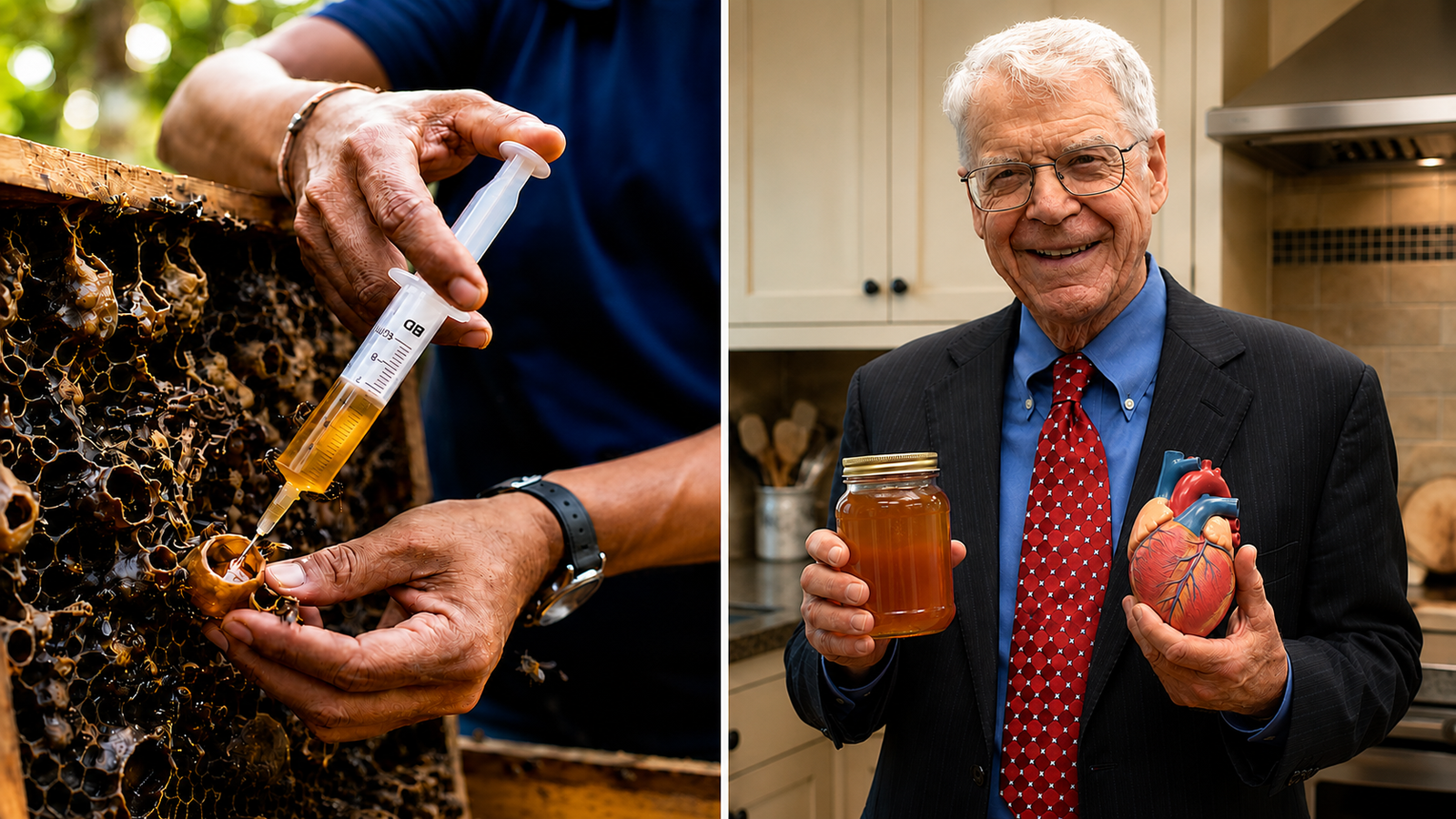
"These medications were designed to treat the symptom. They relax the vessels for a few hours. But the barrier keeps growing."
— Dr. Sanjay Gupta, CNN Chief Medical CorrespondentThe Sardinia anomaly
There is a region in the interior of Italy where the rate of hypertension among adults over 60 is below 5%.
In Sardinia — specifically in the mountainous villages of the interior — researchers have documented the highest concentration of male centenarians on the planet.
Men who have never taken a blood pressure pill. Who eat cheese, drink wine, and reach 95, 100 years old with intact cardiovascular function.
The difference, according to a 20-year study conducted by European researchers, lies in what these men have consumed daily since childhood.
A natural compound — found in high concentration in a honey produced exclusively by native bees in these mountains.
"It's the only natural compound we've documented with this specific action on arterial walls. The problem, from the industry's perspective, is precisely that."
— The lead researcher, to the European pressDr. Gupta explains the full mechanism — and how to replicate the effect of the Arterial Flush Factor outside of Sardinia — in the presentation below.